Consultations are held in German or English. For legal texts, the German version is authoritative.
Removing bowel polyps: snare polypectomy in Vienna
Detecting and removing bowel polyps is one of my main areas of focus in endoscopy. In almost all cases, polyps that are found can be removed during the same session. The examination and the removal are carried out under sedation.
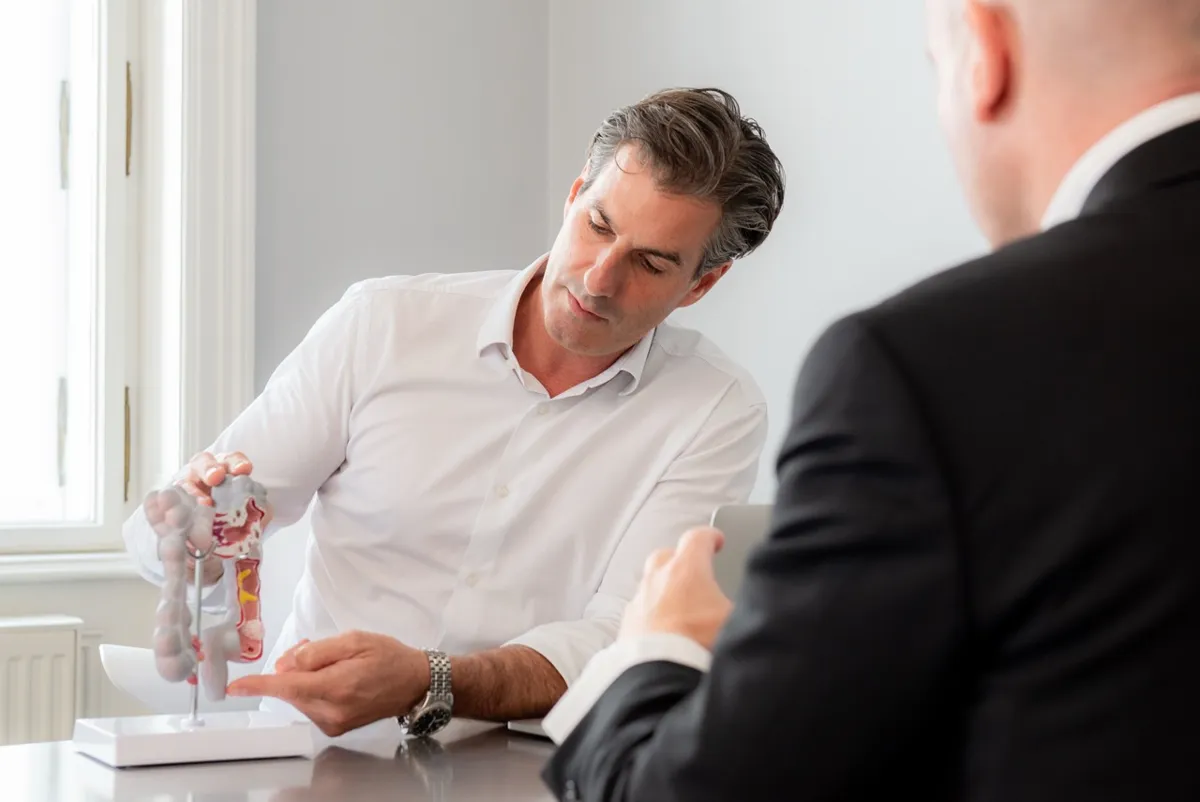
What is a bowel polyp?
Polyps are growths that can arise from and within the lining of the bowel. They can be stalked, broad-based or flat. Not all of them have the same significance. The assessment during the examination and the subsequent microscopic examination (histology) help to determine their type and further treatment.
How are polyps removed?
Very small polyps can be removed with small special forceps passed through the working channel. Larger polyps require what is known as snare polypectomy. A fine wire loop is passed through the working channel of the endoscope and placed around the polyp. Closing the snare removes the tissue. No abdominal incision is needed for this removal.
For some polyps, a cold snare without electric current is used. For others, removal with electrical current is more appropriate. The choice depends on shape, size, tissue characteristics and location. Fluid is often injected beneath the lining before removal. Larger or complex lesions may require a separately planned endoscopic treatment or a different procedure. Not every polyp should be removed immediately in the same session. After removal, I often secure the removal site with a small metal clip.
What happens to the removed tissue?
Wherever possible, the removed tissue is retrieved and sent to pathology. There it is examined to determine what kind of lesion it is and whether there are signs of cell changes. The findings and the removal technique determine further follow-up.
What do I need to tell you before a planned polyp removal?
Bring previous reports, histology results and any available images. Your medication is important, especially blood thinners, as well as any previous bleeding or relevant concomitant diseases. You must not stop taking blood thinners on your own. Planning depends on whether only an examination or a specific intervention is already intended.
What are the risks?
Bleeding can occur after removal. Injury to the bowel wall is also possible. The extent of the procedure and personal risk factors influence the risk. In individual cases, further endoscopic treatment, a longer stay or an operation may become necessary.
After the polypectomy
After the polypectomy you will be monitored and cared for in the recovery room. Most patients can leave the hospital one hour after the procedure.
As soon as the histology is available, I will discuss the result and follow-up planning with you. The follow-up interval is individual and may be shorter for larger lesions removed in several pieces.
About colonoscopy · Aftercare and sedation · Request an appointment