Consultations are held in German or English. For legal texts, the German version is authoritative.
Private colonoscopy in Vienna
Colonoscopy allows direct assessment of the lining of the large bowel. My main areas of focus are screening and the removal of polyps. I carry out the examination personally in one of four private hospitals in Vienna – always under sedation and supported by a well-practised team.
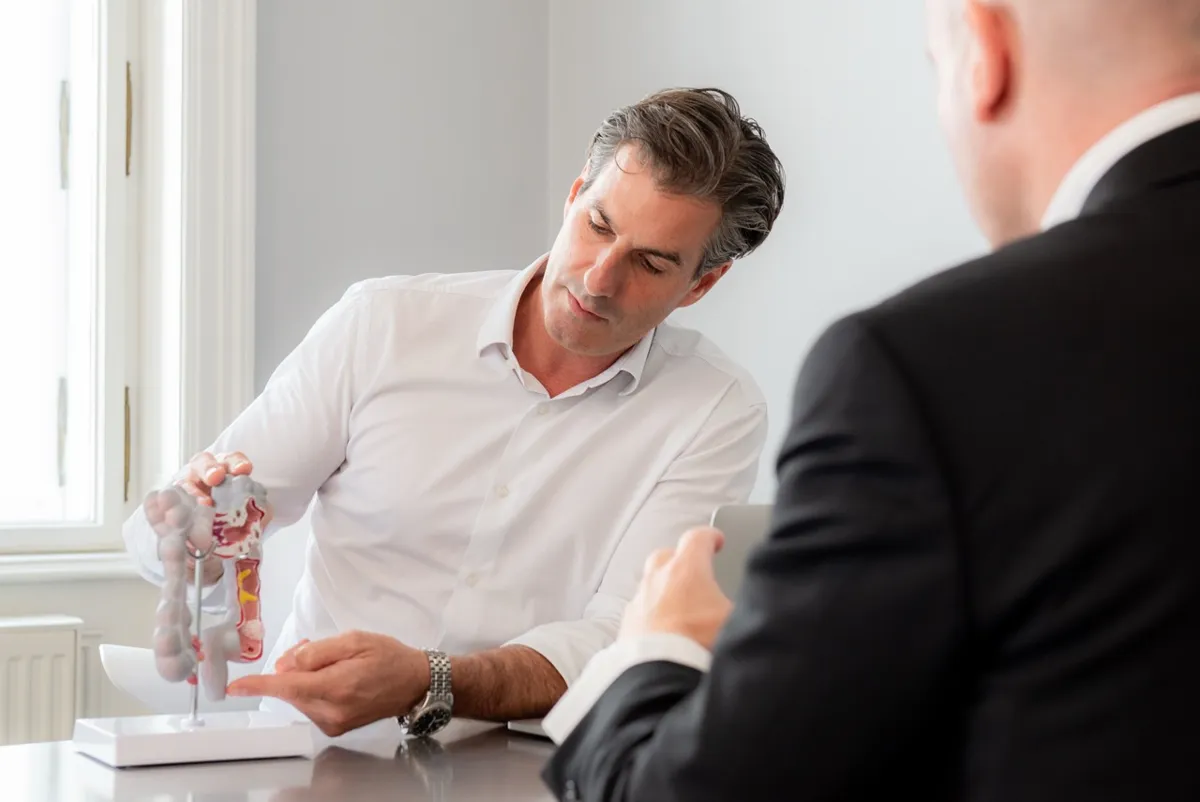
Screening colonoscopy without a prior practice appointment: For a purely preventive check-up without particular symptoms, a direct appointment request is also possible – with a registration form completed online, the signed informed consent form and a short phone call to clarify any open questions. You choose your preferred date directly online from the available endoscopy slots.
What is examined during a colonoscopy?
A flexible endoscope with a camera is inserted through the anus and advanced through the large bowel as far as the junction with the small bowel. As I withdraw it, I carefully assess the lining. Folds, small elevations and conspicuous areas must be clearly visible. If necessary, tissue samples can be taken or polyps removed.
I use CO₂ to open up the bowel. The gas gently distends the bowel and allows a precise assessment of the lining. It is rapidly absorbed by the body and exhaled via the lungs. As a result, there is usually less bloating and feeling of pressure after the examination than when room air is used.
When is a colonoscopy advisable?
Besides screening, a colonoscopy may be indicated for blood in the stool, an abnormal stool test, certain changes in bowel habits, or as a follow-up after previous polyps. Further tests are often needed in addition to the colonoscopy.
For chronic inflammatory bowel diseases or suspected food intolerances, assessment by an appropriately specialised gastroenterologist is advisable. Comprehensive care for these conditions is not one of my areas of focus.
Should my colonoscopy reveal signs of chronic inflammatory bowel disease, I will arrange further investigation and put you in touch with colleagues who specialise in this field.
Quality begins with bowel preparation
Stool residue can hide small polyps. That is why it is important to follow the agreed preparation schedule. I prefer Pleinvue, provided it is suitable for your state of health. You will receive specific intake times matched to your examination appointment.
The day of the examination
Please arrive at the private hospital in good time. First, all the necessary documents and forms are completed. You will then receive a gown suitable for endoscopy and a bathrobe. You will then be taken to the endoscopy room, where an intravenous line will be placed. Sedation and monitoring are coordinated with the anaesthesia team.
While I perform the examination, specialised endoscopy nurses assist with the instruments and, if required, with polyp removal. In addition to the examination itself, allow sufficient time for admission and recovery. If an intervention is carried out, your stay may be longer.
What happens if a polyp is found?
In almost all cases, polyps that are found can be removed during the same session. Size, shape, location and the assessment of the tissue are decisive. Blood thinners and other risk factors also play a role. For complex lesions, a separately planned procedure may be more appropriate.
After the colonoscopy
All patients are monitored and cared for in the recovery room. You will only be discharged once your recovery is sufficiently advanced. On the day of the examination you must not drive a vehicle or operate dangerous machinery after sedation. You may eat and drink again afterwards.
In most cases I briefly discuss the findings with my patients immediately after the examination. Please understand that a detailed discussion is not possible at this point, as it would delay the examinations scheduled after yours. If polyps were removed or tissue samples taken, the pathology result will follow later. This also determines when the next follow-up is advisable.
What are the risks?
Colonoscopy and polyp removal are very safe procedures. Complications are very rare. Possible risks include bleeding, injury to the bowel wall and reactions to the sedation. Severe abdominal pain, fever, heavier bleeding or circulatory problems after the procedure must be assessed by a doctor immediately.